
Not the same but the same
A Link Between Worlds takes place in the same Hyrule as A Link to the Past, only six generations has gone by. Hence, the Link we play as now isn't the same as the Link in ALTTP. Much like A Link to the Past, this game features a dual-world with one being the sunny Hyrule and the other a darker, more corrupt alternative, which is called Lorule this time, with alternative versions of people like Zelda (called Hilda) living in the kingdom. While Lorule isn't technically the same thing as the Dark World in A Link to the Past, it looks and feels very much the same, though with similar kind of differences to the Dark World of ALTTP as ALBW's Hyrule in comparison to ALTTP's Hyrule.
 |
| The events of ALTTP are a thing of legend in ALBW (pun intended). |
The story itself starts of in a somewhat similar manner as well, though the early moments aren't quite as dark as A Link to the Past's. You are an apprentice of the blacksmith and are late for work. You get to work and after being chastised by your master, you get a job to deliver a newly forged sword to a captain of Hyrule castle who forgot to take it with him. This leads you to run around for a while until you are directed to the same sanctuary that was a part of ALTTP's beginning.
 |
| Same home sweet home. |
In the sanctuary, a new villain Yuga appears and transforms one of the new sages, Seres, into a painting. You try to fight against him, but are unable to do anything. After a few other events, Hyrule Castle is under dark magic and no one can enter, which sends Link to find the same three pendants that he had to find in ALTTP so that he could go retrieve the Master Sword which can then be used to dispell the magic surrounding Hyrule Castle. Of course Link doesn't win Yuga even as he does this and while Link has been running around to find the pendants & Master Sword, Yuga has painting-fied the rest of the sages. They move to Lorule where Yuga uses the painting-sages' powers to unleash a kind of Yuga-Ganon fusion onto the world. Hilda saves Link but in the process the Sage paintings are scattered all around the kingdom. Much like the Dark World, Lorule has seven dungeons/castles Link has to go through to save the sages.
 |
| The world is a bit TOO similar to A Link to the Past's, for being a sequel. |
The biggest difference between ALTTP and ALBW is that ALBW is less restrictive in how to tackle the game. You can actually rent all of the items (except one) from the start, so apart from big boulders and a couple of other kinds of obstacles, there's really not much that stands in your way of going through the dungeons in any order you want. I'm not sure if it's more of a mental thing, but I liked ALTTP's approach more. It felt like every new item & skill gotten and every dungeon beaten took me closer to the climax of the story, with Link gaining more experience & preparing to take on Ganondorf with all of his new equipment. In ALBW I was kind of just doing the dungeons in whatever order and got the more powerful items so early on that I never felt any kind of progression, never feeling that kind of build-up to the finale because neither the gamepley nor narrative was pushing me into it like it did in ALTTP. I was just suddenly standing in front of Lorule Castle, ready to take on the final dungeon & battle. Other than having more hearts and a better tunic & sword, I didn't feel all that different from the Link that I had been when I first entered Lorule.
 |
| I've got the power! |
Wall-merger all the way
The big gimmick of ALBW is that Link can merge himself into a wall as a kind of painting and move around on walls' surfaces (though only left & right). It's used to get over & around gaps, move through tight spaces, evading enemies and popping out of the walls to push stuff that's laying against the wall. It is used a lot during the game, perhaps a bit too much, as it feels most of the items aren't used much at all while it's rare that more than one minute goes between wall-merging. The good thing is that it's not a lengthy process. You pop-in and pop-out of the wall very quickly so it doesn't become too tedious to use it and it just becomes one form of traversal. Even then, the problem really is that the rest of the tools take a backseat.
 |
| Be prepared to see a lot of this. |
Even in dungeons that supposedly focus on certain item's usage, the wall-merging is used for a lot of puzzles that overshadow the items. This is a bit disappointing as the use of the items almost never goes beyond anything that was already done in ALTTP. As a sequel to ALTTP, I'd have hoped that they'd come up with new, inventive ways of taking advantage of old items. And while there are a few times when some old stuff is used in ways that I don't remember them being used in ALTTP, those instances are far too rare. The problem with this is that there really isn't all that much they do that uses the wall-travelling in inventive ways, so it ends up making the puzzles throughout the game feel a bit same-y. Most of the time, it's mostly just about noticing that you can use the wall-travel in certain situations instead of figuring out how to use it to your advantage.
 |
| Rent-a-thon. |
Another thing that ended up bothering me is the uneven difficulty level, especially when it comes to the combat. The beginning of the game felt exciting. Enemies could kill you quite easily if you weren't careful. I had rented almost all of the items and because I actually felt vulnerable, there was the kind of tension that I could lose everything if I died that the often-too-easy Zelda series rarely has. But this was quickly done away by the abundance of hearts and the new tunics that halve damage, so the game turns ridiculously easy quite abrubtly quite soon after arriving to Lorule. Only the final boss offered some challenge after the first few hours and even that only because I didn't actually find the second tunic. The game does offer a more difficult Hero Mode after beating the story once, but I don't feel like playing through the game again this soon, so its worth will have to wait for another time. If only it had been available from the start.
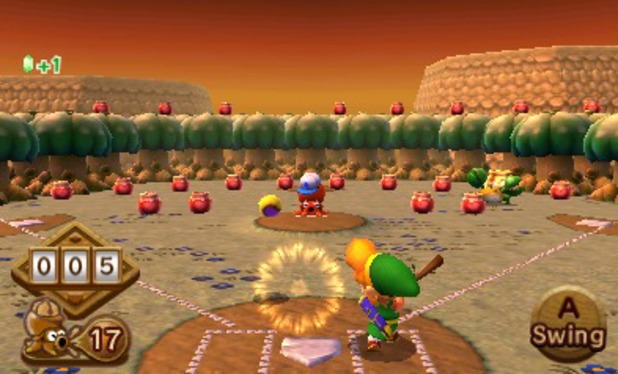 |
| Perhaps the most surprising minigame I've experienced in a Zelda game. And I hate it. |
Perhaps the biggest complaint I have of ALBW is not about its quality per se, but more about its nature as not-quite-a-full-fledged-sequel to ALTTP. It feels more like an alternate take on A Link to the Past instead of an innovative continuation to its formula like what Majora's Mask was to Ocarina of Time. The world is different but it's almost the same. The dungeon layouts are different, yet the dungeons mostly function in the same way, having many of the same gimmicks yet oftentimes they aren't even as challenging as ALTTP's dungeons. This feels almost more like a more extensive Ocarina of Time's Master Quest like rework of the original ALTTP with a slightly altered storyline than a completely new Zelda game. It perhaps plays a bit too much on nostalgia and is too afraid to make bigger changes to the formula. Fortunately, even if the game perhaps feels a bit too much like a retread of A Link to the Past instead of an innovative game of its own, it's still a high quality game.
Another nitpick I have is the rewards this game gives you. Way too much of it was rupees and some of the rewards were shockingly unrewarding. I threw what felt like thousands upon thousands of rupees into a fairy spring and what did it give me as a reward? The FIFTH bottle, as if the four I had already weren't enough. What did feel rewarding were the upgrades to my items rewarded for finding all the Maiamai squids. The upgraded items felt suitably powerful. But otherwise, most everything else was Rupees, with a few heart pieces sprinkled here & there.
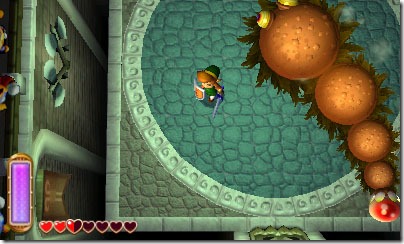 |
| Long time no see, d00d. |
One neat feature is that A Link Between Worlds makes use of the StreetPass feature of 3DS. You can open up your 3DS to download challengers from other ALBW owners in the form of Shadow Links. They are other people's Links as they were at the time of the StreetPass pass-by, only controlled by AI that tries to emulate how the owner of the Shadow Link would play, with the equipment & hearts that the player's Link had. Unfortunately I only confronted one other person with ALBW, so my experiences with this are not that extensive. It seemed like something that could be fun if you live in an area with more 3DS owners, but my particular opponent was so weak that it wasn't much of a fight.
Well excuse me my smooth moves, princess
If there's something that I can't find any kind of fault in, it's the audiovisual side of A Link Between Worlds. The 3D effect is extremely well done (especially nice on New Nintendo 3DS' screen), the graphics are teeming with all kinds of nice details & personality that very few developers can do like Nintendo, it all runs so smoothly at 60fps no matter if you play with the 3D mode on or off and they have shifted the ALTTP 2d style into 3d pretty much perfectly. Although the graphics are a bit simple, it's still a very nice looking game and a joy to see in such smooth motion.
The music is an unbelievably great mix of completely new compositions and old tunes made anew with genius level orchestral arrangements that not only do good with the old melodies but also add new layers & extensions of greatness into them. The old melodies are recognizable yet fresh enough that it doesn't feel too safe. Ryo Nagamatsu has done an amazing job in arranging & upgrading Koji Kondo's old soundtrack to new orchestrated heights as well as offering worthwhile new music that will likely have earned its place among the best of the Legend of Zelda franchise's rich history of beautiful music once all things are said & done.
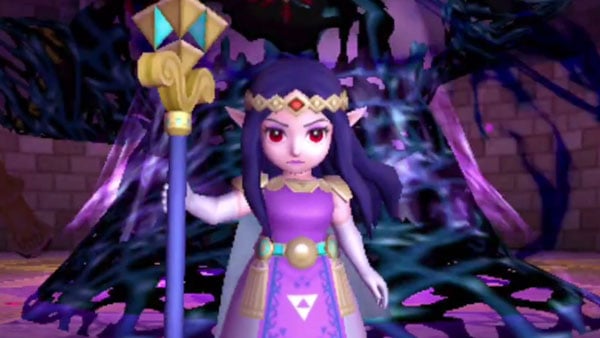 |
| Meet Hilda. She's like Zelda, but with a totally innocent black/blue-ish hair. |
Verdict: GREAT. After the extremely disappointing handheld adventures in Phantom Hourglass and Spirit Tracks, which I personally consider thoroughly mediocre or even below mediocre games, A Link Between Worlds is a return to form for handheld Zeldas. The openness of the game's structure does mean some of the sense of progression is lost and I do have a lot of other complaints about the game's nature as a kind of half-remake, half-sequel, but in the end I can't say I didn't enjoy the game. Despite all my nitpicks with it, it did sink its hooks on me and it didn't take more than a few evenings to play through the game. I guess my biggest problem with ALBW, in retrospect, ends up being the fact that it either does things a tiny bit worse than ALTTP or doesn't do them better/different enough, not that anything it does sucks complete & utter ass.
It's a quality game, but feels like a (re-imagining of a) game that I already played when I was around 7 or 8 years old. Not a bad thing per se, but not quite the sequel I was hoping for. I guess it ended up harming the experience a bit when Miyamoto & Co couldn't decide whether to just remake A Link to the Past or if they should make a proper sequel, so they kind of did something in between. Maybe my expectations were a bit too high, but as a sequel (especially as a sequel to a Zelda game) this is a bit disappointing in how overly safe it seems. While it's nice to see old environments again, at some point you do kind of go "so what's so different about this?" As a game it's still a great one far above most other action adventure games that are usually just pale imitations of Legend of Zelda games.
p.s. I absolutely loathe the baseball minigame and it will probably be the reason why I'll never truly 100% this game. >_<
INFO BOX
Publisher: Nintendo
Developer(s): Nintendo EAD Group No. 3, Monolith Soft
Platform(s): Nintendo 3DS, New Nintendo 3DS
Release
Date (Europe): November 22nd, 2013
Number of players: 1


